
Habitat & Conservation
|
07/17/2026
Lessons Learned from my Micro Pollinator Habitat
How my tiny pollinator patch has changed my perspective on grasslands and conservation.
by Gilbert Randolph
Related Articles


I can't confirm this, but I may have the honor of conducting the world's smallest prescribed fire. Covering an area about five foot wide and six foot long, my burn was aimed at knocking back the cool season grasses that had begun to creep into my pollinator patch. In case my city is reading this, I went through the whole safety process prior to the burn. I made a fire line, had my hose and rake ready in case it started to get out of control and waited for a low-wind day. All in all it was a smashing success. My twin mattress sized burn went off without a hitch. At least, I thought it had.
Lesson #1 : Sometimes we need herbicides
Not long after my burn, I noticed that the crab grass was starting to re-sprout. In theory, I knew burning doesn't always eliminate invasive species. I'm not entirely sure what sort of grass my front yard is comprised of, but it seems that crab grass is always appearing in a patch of open ground, a gap between rocks and even the slightest bit of dirt in my gravel drive.
I had spent a lot of time removing grass shoots from the ground throughout the summer and as my native plants went into dormancy, the cool season non-native grasses quickly tried to take over. Even after the mini burn, I needed to do more. So I turned to a grass formulated herbicide and did very targeted spraying. The next spring when I reseeded the area, my native forbs were able to take up the space much more effectively. While herbicides should always be treated with caution, there are times, particularly on a large scale, when they can be a powerful tool to help stop the momentum of non-native plants and give native grassland species the head start they need to get established.
Lesson #2 : Best laid plans sometimes fail
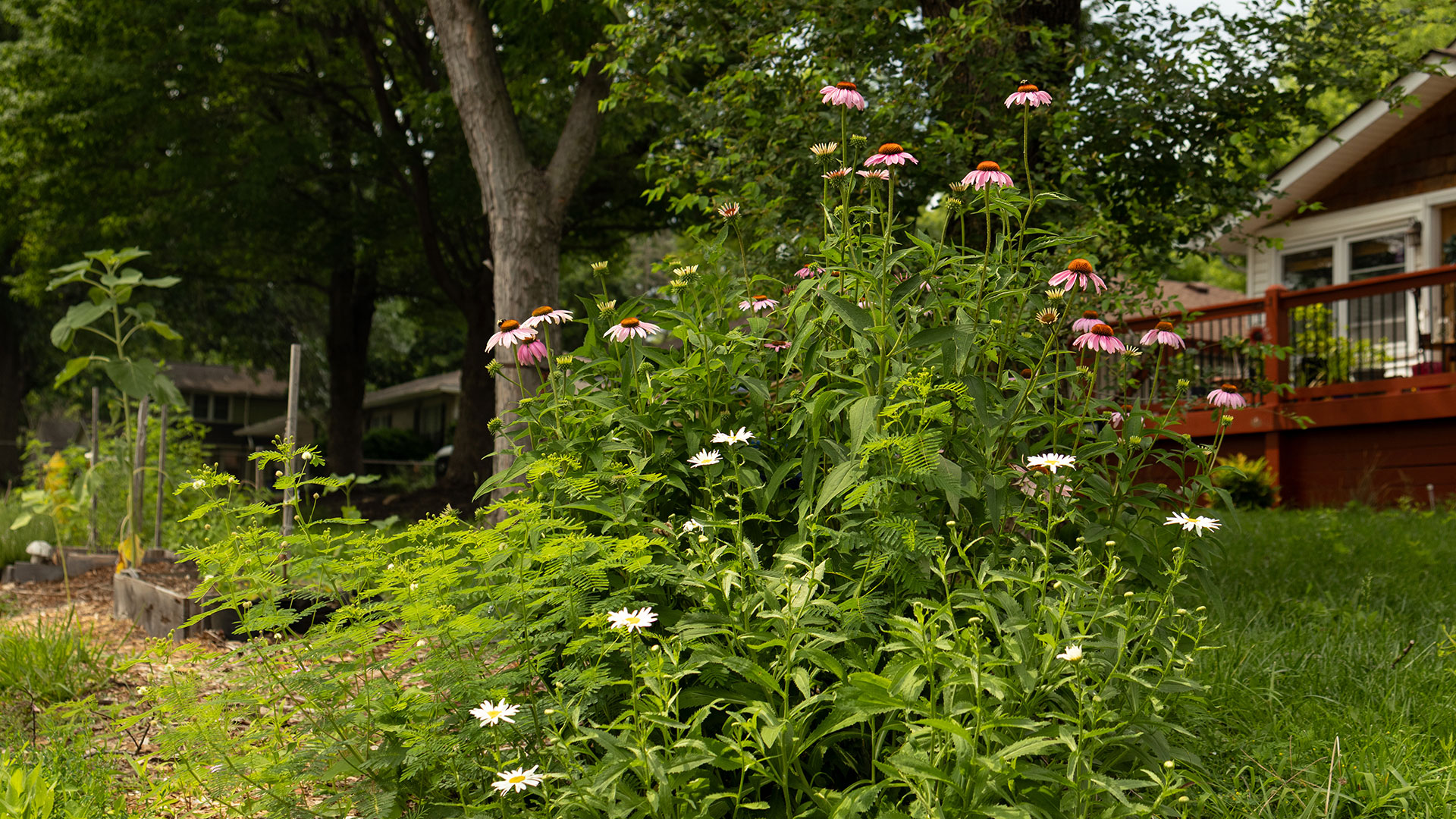
The two biggest failures in my pollinator plantings have come because of unexpected construction projects and my own miscalculations. The first was an event entirely out of my control. The city installed new water mains, which meant they not only destroyed my precious pollinator plants, but also laid down a freshly excavated mixture of hard clay and chunks of asphalt in the spot where it had been. I had to start back at square one. I brought in a bit of new soil, straw and fresh seeds. While the other patch which hadn't been affected by the digging was blooming into coreopsis and coneflower, that section had to start anew. If you're planting in a spot that has the potential to be disturbed against your will, just be aware that your hard work could be erased by something as random as a burst pipe.
The other major mistake I made was putting too many oak leaves over the planting. I wanted to make sure there was plenty of organic material to help build up the topsoil, as well as provide insect habitat over winter. In my enthusiasm for leaving the leaves, however, I went too far. I single out oak leaves because unlike the silver maples, hackberries and elms in my yard, the oak leaves did not deteriorate and disappear by spring. They formed a dense mat the new pollinator seedlings were having a difficult time penetrating. While I am still a believer in foregoing most raking, next year I will be paying more attention to how much leaf litter I am leaving behind so the new spring growth won't be impeded by too much leaf cover.
As with my small plot, sometimes the best laid plans fail on a larger scale. The weather doesn't cooperate, a contractor messes up and sometimes you just have plain bad luck. Improving habitat is hard work and even small improvements are worth celebrating.
Lesson #3 : Field buffers aren't just fluff
I'm a mediocre gardener, so I blamed the failure of my tomato plants on the weather, bad luck, the moon phases and whatever other excuse I could conjure. The truth was, I had built my raised beds too close to the trees in my front yard because it was the only stretch where I could get something approximating full sun. The beds were fine the first year, but by the second, they became entirely taken over by tree roots. It wasn't worth the work of planting to have such poor yields.
My pollinator plots, however, managed to establish themselves in spite of the tree roots. In terms of wildlife management and precision ag, it's a perfect illustration of why field borders can be a powerful tool for conservation. Like my tomato plants, crops planted next to tree lines simply can't compete with the trees for nutrients and sunlight. These low production areas can often end up losing money for farmers. Putting in pollinator habitat through programs such as the Environmental Quality Incentives Program can turn those unproductive zones into highly valuable wildlife habitat.
Lesson #4 : The reward is the planting itself
Ragweed is rough on me, but ever since I've learned that ragweed is a highly useful plant for wildlife, I haven't looked at my allergies the same. Whether it's the Jurassic Park like ferns of Illinois bundleflower or the bold colors of native wildflowers, the sheer variety of plants in my pollinator patch have become a reward in itself. Now when I visit conservation areas, go hunting or see someone else's planting, I can recognize and appreciate species I would have never noticed before. Not only that, but my pollinator plantings draw in a surprisingly diverse cast of insects and birds.
Ultimately, my small patch of pollinator habitat hasn't just taught me practical lessons about maintaining land and keeping out invasive plants. It has helped me to value the riotous variety of living things that thrive when our native grassland species are given the opportunity to flourish. A small patch in my front yard may not have a big impact by itself, but as more people create similar plantings and learn to love grassland habitat as well, that impact can't help but grow.
Your cart is empty